
Turning Personal Insight Into Everyday Progress
Most of us have something we want to change.
We may want a more fulfilling career, a stronger business, healthier relationships, or greater confidence in the decisions we make. We can often picture the outcome. The challenge is knowing how to move toward it while managing everyday responsibilities.
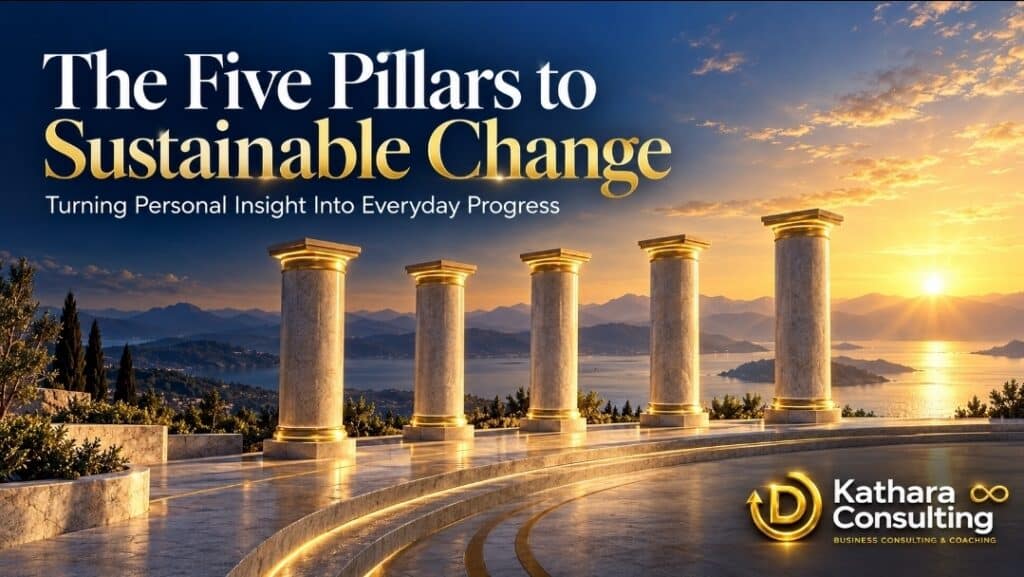
I developed “The Five Pillars to Sustainable Change,” to provide a practical structure for that process.
Refined through years of coaching and client work, the framework invites you to examine what you want, recognize what is getting in the way, and take purposeful steps forward.
1. Core Desires & Setting Intention
Change begins with understanding what matters to you.
It is easy to pursue goals shaped by other people’s expectations or continue along a familiar path without questioning whether it still fits.
This pillar creates space to ask: What do I want to experience, contribute, or achieve? Why does it matter? What would meaningful progress look like?
An intention gives that reflection direction. “I want better balance,” for example, becomes more useful when you define the boundaries, choices, and experiences that balance would involve.
2. Removing Obstacles
Once your direction becomes clearer, you can examine what stands in the way.
Some obstacles are practical: limited time, missing skills, financial constraints, or insufficient support. Others involve fear, avoidance, habits, or assumptions about what is possible.
Identifying the obstacle helps you choose an appropriate response. You may need a resource, a conversation, a new skill, or a different way of approaching the situation.
The aim is to work with the actual barrier rather than remain caught in a general feeling of being stuck.
3. Developing a Positive Mindset
This pillar encourages you to pay attention to how you interpret experiences and speak to yourself.
When something goes wrong, do you treat it as a reason to stop? Can you identify what happened, what you learned, and what you might try next?
A positive mindset can include honesty about disappointment and uncertainty. It also makes room for curiosity, possibility, and a constructive response.
These are qualities you can practise in ordinary moments.
4. Building a Solid Foundation
Your goals need support in your daily life.
That foundation may include healthy boundaries, supportive relationships, time for reflection, and routines that help you manage your energy and responsibilities.
Consider a goal you have struggled to maintain. What conditions would make it easier to follow through? What repeatedly pulls you away from it?
Sometimes progress requires adjusting the environment around a goal as much as strengthening your commitment to it.
5. Taking Effective Action
Insight becomes useful when it informs what you do next.
Choose an action that connects directly with your intention. Make it specific enough to complete, decide when you will do it, and review what happens.
Effective action also involves adjustment. Experience may reveal that you need a different approach, more information, or additional support.
The pillars can be revisited throughout that process as your understanding grows.
A Framework You Can Return To
The Five Pillars offer a structure for personal reflection and development across work and life. They can also provide a starting point for coaching conversations about goals, habits, confidence, and follow-through.
You do not need every answer before you begin. Start with one area that matters and give yourself room to explore it honestly. Interested in applying The Five Pillars to Sustainable Change in your life or organization? Connect with Kathara Consulting to learn more about the program and optional mentoring and coaching